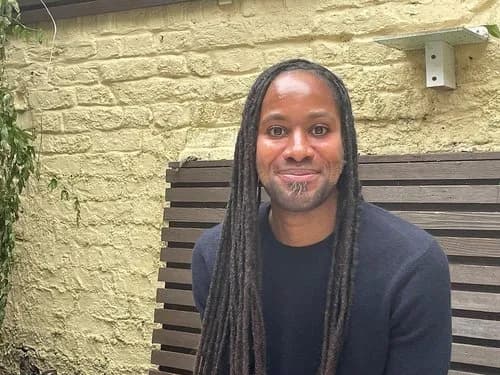
Why did Jason Arday resign? All the claims against Londoner as Cambridge's youngest black professor quits
Originally from The Evening Standard. Read the original article on the publisher’s site.
Jason Arday resigned on Wednesday following a series of allegations regarding his achievements and evidence of plagiarism in his PhD thesis and published articles.
Jason Arday, the Cambridge professor at the centre of a plagiarism row, resigned "with immediate effect" on Wednesday evening after being placed under investigation.
The university said that the inquiry into Mr Arday came "following new information" about his "academic qualifications and honorary appointments".
It comes following a series of reports regarding his achievements and evidence of plagiarism in his PhD thesis and published scholarship.
Mr Arday has admitted errors in his work, but said he was not a liar, amid “an unrelenting level of public scrutiny and personal attack”.
He said his resignation should not be “mistaken for an acceptance of the narratives that have surrounded me”.
In his statement, he said that he had resigned as the “relentless accusations, speculation and public commentary have taken a profound toll on me and on those I love”.
So, who is Jason Arday, and what are the claims against him?
Who is Jason Arday?
Jason Arday was appointed as professor of sociology at Cambridge in 2023, becoming the establishment’s youngest black professor at the age of 37.
Mr Arday claims that he was diagnosed with autism at the age of three, was unable to speak until he was 11, and could not read or write until the age of 18.
Mr Arday supposedly overcame all these factors, attending university and climbing the academic ladder, receiving his PhD in 2015.
He later held academic posts at Leeds Beckett, Roehampton and Durham universities, and was appointed professor of sociology of education at Glasgow University in 2021, before his move to Cambridge in 2023.
What are the allegations against him?
Allegations that he plagiarised his PhD thesis and other research
There have been a number of reports that Mr Arday plagiarised his PhD thesis and other research.
These accusations were first voiced by Nathan Cofnas, a US researcher.
Mr Cofnas put Mr Arday's work through plagiarism detection software, finding that "many passages are lifted with minimal editing, sometimes retaining copy-editing mistakes from the original source".
A subsequent investigation by Liverpool John Moores University, which awarded his PhD in 2015, did not uphold the plagiarism charges but said they were probably caused by “honest and reasonable error”.
More recently, The Telegraph reported that analysis had found more than 100 passages in Mr Arday’s PhD were similar to a thesis by Brunel student Paula Zwozdiak-Myers, which was published six years earlier.
John Preston, an emeritus professor of sociology at the University of Essex, told The Guardian: “Having seen the evidence, it triangulates and there is, in my judgment, a case to answer here.”
Mr Arday has denied all accusations of plagiarism, saying: “There have been multiple thorough investigations across several institutions as a result of the allegations, and immense scrutiny, including with an academic misconduct panel who concluded that there was no plagiarism or academic misconduct.”
Running and fundraising feats
Mr Arday has claimed to have completed 30 marathons in 35 days, and 600 miles in six days, as well as raising £5.5 million for charity.
He has since revised some of those claims, including telling the Guardian that the money was raised with the help of others over a two-decade period, who he cannot name due to the signing of non-disclosure agreements.
He also said that the 600 mile challenge, completed on a treadmill, was actually completed over 12 days to allow for rest days due to "cumulative wear and tear”.
Regarding his other records, Mr Arday told the Times: "I can't make people believe me. Nobody lives their life having a receipt for every single thing they say or they've done."
Fellowships at other institutions
Mr Arday has claimed that he has held a number of visiting fellowships and professorships at other universities.
These include statements dating back to 2018 that he was a visiting fellow or visiting professor at Ohio State University in the US, who have denied that Mr Arday was ever employed in any role.
Attacked with knives
Mr Arday told the Guardian that, since his appointment at Cambridge, he has received multiple threats, including being targeted by knife-wielding masked intruders.
He said that he was confronted at his faculty building on two occasions by a masked man threatening to harm him if he did not resign, who evaded detection on both occasions.
Mr Arday said that on the second occasion the intruder produced a knife and threatened him with it. He did not inform colleagues that a masked man with a knife was in the faculty building.
Subsequent investigations found no evidence to support his claims.
Pig’s head delivered to his parents’ home
Mr Arday has also claimed that a severed pig’s head was delivered in a large cardboard box to his parents’ home address in south London.
He claimed to have intercepted the package and immediately thrown it away, only telling the police several months later.
He said that the police investigated, checking with butchers in south London if they had sold a pig, but when the Guardian checked those details with the local butchers Mr Arday named, they said no police officer had come in to ask them about a pig.
When details Mr Arday gave about the pig’s head investigation were checked, the Met told the Guardian that they were “categorically” incorrect and no investigation had taken place.
What did Jason Arday say in his resignation letter?
In his resignation letter, Mr Arday said: “While criticism is an inevitable part of academic life, what I have experienced has gone far beyond scholarly disagreement.
“The relentless accusations, speculation and public commentary have taken a profound toll on me and on those I love.”
In the statement, which was posted by the Good Law Project, Mr Arday said he had "concluded that the only way to bring this chapter to an end is to step away".
Mr Arday said that being appointed professor had been "without question, the greatest professional privilege of my life" but that there “comes a point when the personal cost becomes too great."
“This decision should not be interpreted as a loss of faith in scholarship or in the values that first brought me to Cambridge. Nor should it be mistaken for an acceptance of the narratives that have surrounded me.
He said "this is not the end of my work" and that he needed "time to heal".
"When that time comes, I will return," he added.
What has the University of Cambridge said?
Cambridge initially defended Prof Arday, saying that allegations made against him were a "vile campaign to undermine his credibility".
However, on Wednesday, the university of Cambridge said it had begun an investigation into the professor "following new information".
A statement added: "Separately, there remains a number of ongoing complaints regarding academic misconduct, which are being handled in line with our Misconduct in Research policy.
"While we are fully aware of the public commentary and concerns around this matter, it remains vital that any process is thorough and adheres to both university policies and employment law.
"We also fully recognise that there is a person at the centre of this situation, and we continue to provide support to him."
A spokesperson for Jesus College, where Prof Arday is a fellow, said it was launching its own process "parallel" to the university's investigation.
They said: “Prof Arday remains a fellow during this process. We recognise that this is a very difficult time for him and his family, and ask that they are treated with compassion and respect.”
This article was legally licensed by AdvisorStream.
Related Articles

Energy bills are set to rise twice — here’s what to do if you’re struggling
Energy bills will rise in October and likely again in January for those not already on fixed deals.

Why caffeine makes some people buzz — and others barely notice
Why can some people drink coffee before bed and sleep like a baby, while others lie awake staring at the ceiling?
UK credit scores: should you worry about a big shake-up?
Your rating is vital when taking on debt, but you could be in for a surprise as a big player changes its rules.